top of page

What Are the China Top 10 Flowable Composite Suppliers?

China’s dental materials industry has become an important sourcing base for restorative products, including Flowable Composite. Demand is supported by rising oral healthcare needs and expanding private dental services. The World Health Organization’s Global Oral Health Status Report 2022 estimates that nearly 3.5 billion people experience oral diseases worldwide. That figure shows the scale of restorative care, although it does not measure composite demand directly.

This article examines ten Chinese suppliers associated with flowable restorative materials, private-label production, or dental consumables. The selection considers product range, manufacturing experience, quality systems, export capability, and technical documentation. ISO 4049 remains a relevant reference for polymer-based restorative materials. Suppliers may also present ISO 13485 certification, CE documentation, or other market-specific evidence. These documents matter more than attractive catalog photographs.

Market research reports from Grand View Research and Fortune Business Insights describe steady growth in global dental composites and broader dental consumables. Their market definitions differ, so reported values should not be compared mechanically. That limitation deserves attention. A supplier ranking is never perfectly permanent. Prices, formulations, certifications, and distributor relationships can change within one year. Buyers should request current technical data sheets, safety documentation, batch certificates, and sample evaluations before purchasing.

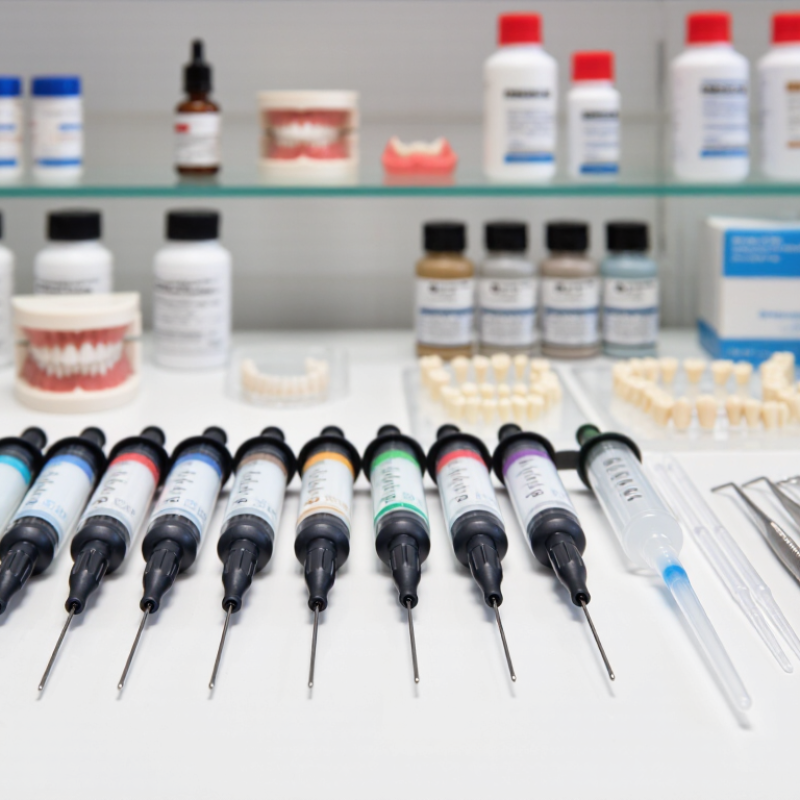
The following supplier overview is designed for practical comparison. It focuses on observable capabilities rather than promotional claims. Clinical performance still depends on curing light intensity, shade selection, handling technique, and storage conditions. A small syringe can reveal major differences. Viscosity, adaptation, radiopacity, and polish retention deserve careful testing. This guide offers a starting point, not a substitute for independent verification.
What Are the China Top 10 Flowable Composite Suppliers?

What Are Flowable Composites and How Are They Used?

Flowable composites are low-viscosity, resin-based restorative materials designed to move into narrow spaces. Their filler content is usually lower than that of heavily packed composites, allowing easier placement and smoother adaptation. Under a curing light, the material hardens into a tooth-colored restoration.

Their practical value appears in small cavities, pit and fissure sealing, cervical repairs, and thin liners beneath stronger restorative layers. A narrow syringe tip can reach an irregular margin, while the material spreads across tiny grooves like liquid paint. Good isolation remains essential. Saliva, moisture, or trapped air can weaken bonding and create visible defects.

Flowability is helpful, but it is not unlimited. Some formulations may show greater shrinkage or lower wear resistance than heavily filled materials. They may not suit large, load-bearing areas without proper support. In practice, dentists should check viscosity, curing depth, working time, and compatibility with the bonding system. A powerful curing light does not fix poor placement. That is an easy mistake to overlook.

Suppliers should provide clear technical data, batch traceability, storage guidance, and realistic clinical instructions. Selection should depend on the case, not marketing language alone. The best material is often the one that adapts predictably, cures completely, and remains stable during everyday chewing. Be cautious with universal claims.

What Are the China Top 10 Flowable Composite Suppliers? - What Are Flowable Composites and How Are They Used?

An anonymized comparison of typical supplier capabilities, product specifications, and clinical applications in China’s flowable composite market.

Rank Anonymized Supplier Profile Typical Product Focus Viscosity Position Typical Filler Loading Curing Options Common Applications Key Selection Criteria Typical Delivery Format
1 Profile A — High-Volume Dental Materials Manufacturer Universal flowable restorative composite Low to medium Approximately 55–70 wt% Light-cure Small Class I, III, and V restorations; liners; repairs Radiopacity, shade range, low polymerization shrinkage Syringe or unit-dose tips
2 Profile B — Private-Label Export Specialist Shade-matched flowable composite line Medium Approximately 50–65 wt% Light-cure Anterior restorations, cervical lesions, masking and contouring Color stability, polishability, private-label flexibility Syringe, capsule, or customized packaging
3 Profile C — Radiopaque Restorative Material Supplier Radiopaque flowable composite for direct restorations Medium Approximately 60–75 wt% Light-cure Posterior small cavities, bases, liners, and repair procedures Radiopacity above dentin, handling consistency, wear resistance Syringe with dispensing needle
4 Profile D — Bulk-Fill Flowable Developer High-depth-of-cure flowable restorative composite Medium to high Approximately 60–75 wt% Light-cure Larger posterior cavities when covered by an occlusal composite layer Depth of cure, low stress, controlled injection, adaptation Syringe or compule
5 Profile E — Low-Shrinkage Composite Manufacturer Stress-reduced flowable composite Medium Approximately 55–70 wt% Light-cure Cervical restorations, deep areas, stress-sensitive adhesive procedures Polymerization stress, marginal adaptation, bond compatibility Syringe or unit dose
6 Profile F — Bioactive-Oriented Material Supplier Ion-releasing or calcium-containing flowable material Medium Formulation-dependent Light-cure Liners, small restorations, minimally invasive procedures Ion release, pulp protection claims, biocompatibility evidence Syringe
7 Profile G — Orthodontic and Preventive Materials Supplier Flowable materials for preventive and adhesive procedures Low to medium Approximately 45–65 wt% Light-cure Pit and fissure sealing, bracket-related repairs, minor defect filling Flow control, moisture tolerance, easy dispensing, retention Syringe or brush-tip applicator
8 Profile H — OEM and Contract Manufacturing Specialist Custom-label flowable composite systems Customer-specified Customer-specified Usually light-cure Private-label restorative, liner, and repair products Minimum order quantity, formulation customization, documentation Customized syringe or compule
9 Profile I — Value-Focused Domestic Supplier General-purpose flowable composite Low to medium Approximately 50–65 wt% Light-cure Routine small restorations, repairs, and cavity lining Cost efficiency, shelf life, basic mechanical performance Syringe
10 Profile J — Specialty Aesthetic Composite Supplier Polishing-oriented and enamel-shade flowable composite Low to medium Approximately 50–70 wt% Light-cure Anterior contouring, enamel repairs, small gaps, and cosmetic corrections Translucency, gloss retention, shade matching, polishability Syringe with fine-gauge tip

What Are Flowable Composites?

Flowable composites are resin-based dental restorative materials formulated with a lower viscosity than conventional universal or packable composites. Their fluid consistency allows them to adapt closely to cavity walls, narrow spaces, pits, fissures, and irregular surfaces.

They are commonly used for small restorations, cervical lesions, fissure sealing, cavity lining, repair procedures, minimally invasive dentistry, and as an injectable layer beneath a more heavily filled restorative composite. Product-specific instructions, curing depth, increment thickness, and mechanical limitations should always be checked before clinical use.

Note: Supplier identities are intentionally anonymized. Filler content, viscosity, curing depth, mechanical properties, regulatory status, and packaging specifications vary by formulation and should be verified through the applicable technical data sheet and regulatory documentation.

How Are China’s Top 10 Flowable Composite Suppliers Selected?

What Are the China Top 10 Flowable Composite Suppliers?

China’s top ten flowable composite suppliers should be selected through evidence, not publicity. The review can begin with formulation capability, annual output, and documented project experience. Flowable composites must spread evenly, fill narrow gaps, and maintain stable viscosity during application. These details matter on a real production floor. MarketsandMarkets valued the global composites market at about USD 74.7 billion in 2023, with an estimated 8.6% CAGR through 2028. This growth increases competition, but it does not prove technical quality.

A reliable selection model should compare test data, quality systems, delivery records, and after-sales response. Relevant checks include tensile strength, flexural strength, curing time, shrinkage, moisture resistance, and batch consistency. ISO 9001 certification can support process control, while laboratory reports should confirm product performance under stated conditions. Suppliers serving construction, electronics, transportation, or industrial repair should provide application-specific samples. Public information is often incomplete. No ranking is perfect. That weakness deserves attention.

Tips: Request three recent test reports and one customer reference. Confirm whether testing used the same temperature, mixing ratio, and curing schedule. Ask for a traceable batch number. A low price may hide higher rework costs. Also, evaluate technical communication before signing a contract; slow answers often predict slow troubleshooting. The final top-ten list should reward measurable performance, transparent records, production capacity, and consistent delivery rather than impressive claims alone.

Who Are the Top 10 Flowable Composite Suppliers in China?

Who are the top 10 flowable composite suppliers in China? A reliable shortlist should focus on verified capability, not advertising claims. The leading candidates usually include dental-material manufacturers from Guangdong, Shanghai, Jiangsu, Zhejiang, Beijing, and Shandong. They supply low-viscosity restorative composites for liners, small cavities, fissure repairs, and minimally invasive procedures.

The strongest suppliers typically offer several shades, consistent filler dispersion, and controlled syringe flow. Their products should show stable handling under dental lights and limited slumping on vertical surfaces. Look for documented quality systems, batch traceability, biocompatibility testing, and export experience. ISO 13485 certification can support confidence, but it should not replace independent product evaluation. Packaging matters too. A well-sealed 2-gram syringe can reduce contamination and material waste.

The top ten should also include suppliers with private-label development, technical support, and flexible order quantities. Some manufacturers provide light-curing data, radiopacity results, and storage guidance. Others remain vague. That is a warning sign. Public supplier rankings are rarely permanent, because capacity, formulation, and certifications change. Even experienced buyers can overvalue price and overlook viscosity drift between batches. A sample test under real clinical conditions is still necessary. Ask for current certificates, recent test reports, and production records before making a final decision.

What Products and Technologies Do These Suppliers Offer?

China’s top 10 flowable composite suppliers mainly offer low-viscosity dental restorative materials. Their portfolios often include nano-hybrid, micro-hybrid, bulk-fill, radiopaque, and injectable composites. These materials support small cavities, liners, fissure repair, and minimally invasive restorations. Shade systems commonly include universal, enamel, dentin, and translucent options.

Technology is the real differentiator. Suppliers use nano-sized fillers to improve polish retention and wear resistance. Modified resin matrices help balance flow, strength, and shrinkage. Some formulations use thixotropic behavior, flowing under pressure but staying stable after placement. LED-compatible photoinitiators can reduce curing time. According to Grand View Research, the global dental composites market was valued at approximately USD 1.8 billion in 2023, with steady growth expected through 2030. MarketsandMarkets also identifies nanotechnology and bulk-fill materials as important market drivers. However, supplier rankings are not perfectly comparable. Export volume, clinical data, and private-label capacity measure different strengths.

Tips: Ask for ISO 4049 test reports, curing-depth data, radiopacity values, and viscosity records. Request samples from different batches. Check whether the material maintains shape after a 20-second curing cycle. A polished surface may look excellent at delivery, yet wear performance needs longer observation. I would also verify storage temperature and syringe sealing. Small packaging details can reveal production discipline.

How Can Buyers Compare and Choose the Right Supplier?

What Are the China Top 10 Flowable Composite Suppliers?

Buyers should compare suppliers by evidence, not catalog size. Flowable composite performance depends on viscosity, filler loading, radiopacity, polymerization depth, and shrinkage stress. ISO 4049:2019 provides useful testing references for polymer-based restorative materials. The World Health Organization’s Global Oral Health Status Report estimates that 3.5 billion people experience oral diseases worldwide. Demand is substantial, but quality expectations are stricter. A supplier’s ISO 13485 certification, batch traceability, technical datasheets, and independent test reports deserve close review. A low price may hide inconsistent curing or difficult dispensing.

For a top-ten supplier comparison, create a weighted scorecard. Give clinical performance 30%, manufacturing controls 25%, documentation 20%, delivery reliability 15%, and total cost 10%. Check radiopacity values, working time, shelf life, needle compatibility, and storage conditions. Ask for samples from three production lots. Then test them under the same light source and temperature. Fortune Business Insights projects continued strong growth in the global dental composites market, with a forecast compound annual growth rate above 7% through the next decade. Growth alone does not prove quality.

Tips: Request raw test data, not only marketing summaries. Compare viscosity after refrigeration and room-temperature storage. Inspect packaging seals carefully. One overlooked detail can affect clinical handling. I would also question unusually perfect claims; real materials have trade-offs. Pilot orders are wiser than large commitments. Supplier communication matters, especially when a batch needs investigation.

bottom of page