Contact Us
Contact Us

Your Total Safe Patient Handling Partner
1000 Items
How to Choose a Screw Dry Vacuum Pump?
Choosing the right Screw Dry Vacuum Pump is not simply a matter of comparing ultimate vacuum ratings. A pump that performs well in a laboratory may struggle beside a coating chamber, chemical line, or dusty packaging machine. The real decision depends on gas composition, vapor load, operating pressure, pumping speed, and daily duty cycle. Small details matter.
This guide explains how to evaluate each factor with practical engineering judgment. It considers rotor design, compression stages, temperature control, noise, energy use, and maintenance access. For example, a pump handling solvent vapor needs different protection from one removing dry powder. A stainless-steel process connection may also be more valuable than a slightly faster pumping speed. Check the manufacturer’s performance curves under realistic conditions, not only the headline specification. Ask for test data, service intervals, spare-parts availability, and documented operating limits. Reliable suppliers should explain these details clearly.
Field assessments often expose overlooked issues. Condensation can damage a seemingly suitable pump. Fine particles can increase wear within weeks. Incorrect sizing may create unnecessary heat, power consumption, and downtime. No choice is perfect.
The best selection balances vacuum requirements with process stability, ownership cost, and technician safety. It also leaves room for honest uncertainty. Process conditions change, and published data may not represent every installation. A careful review, supported by qualified engineers and verified manufacturer information, can prevent expensive mistakes. This article provides a practical framework for making that review more precise, transparent, and dependable.
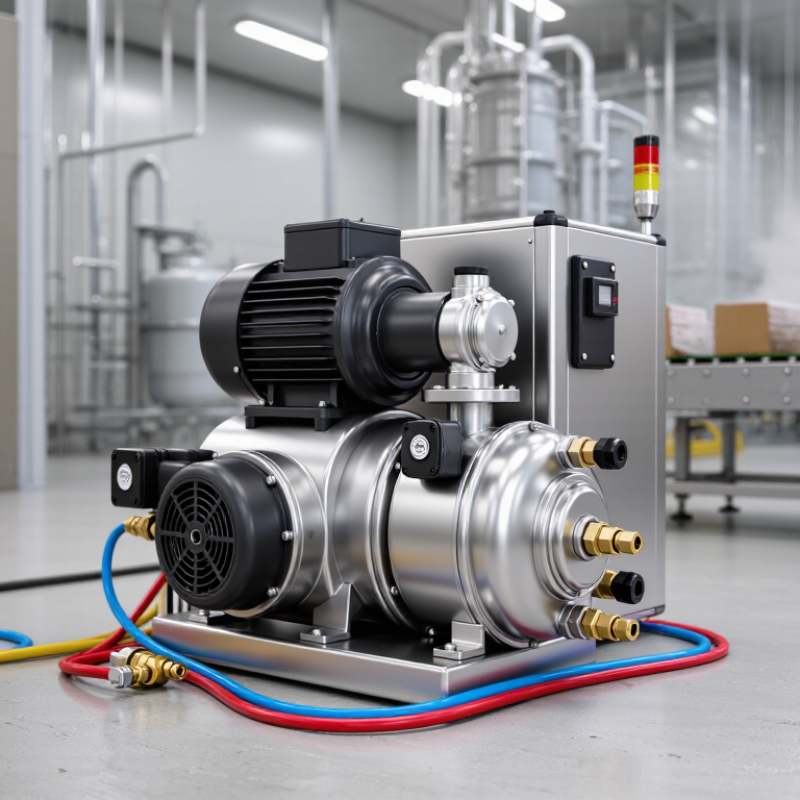
Define Vacuum Duty: Pressure, Gas Load, and Throughput under ISO 21360-1
Choosing a screw dry vacuum pump starts with defining the vacuum duty, not selecting an ultimate pressure from a catalogue. Vacuum duty includes operating pressure, gas load, and required throughput. These values describe the real process better than a single pressure figure.
ISO 21360-1 provides a framework for measuring and reporting pump performance under defined conditions. Use its data to compare pumping speed at the relevant inlet pressure. Do not compare only the stated ultimate pressure. Calculate gas throughput using pressure and pumping speed, while checking consistent units. A practical estimate should include leaks, vapor release, and line conductance. Long or narrow pipework can reduce effective pumping speed significantly.
Gas composition also matters. Air, solvent vapor, water vapor, and corrosive gases place different demands on a dry screw pump. Check the expected inlet temperature, moisture level, particulate load, and operating cycle. A pump handling a brief high gas load may need more capacity than one running continuously at a lower load. Allowing extra margin is sensible, but excessive oversizing can reduce efficiency and control quality.
A neat spreadsheet can still mislead. Process conditions often change after commissioning. Recheck the duty with measured pressure, temperature, and flow data. Confirm whether the published values use the same inlet configuration and test method. Small assumptions matter. A reliable choice connects ISO-based performance data with the actual gas load at the chamber.
| Duty Dimension | Unit or Definition | Reference Data | How to Apply It | Selection Implication for a Screw Dry Pump |
|---|---|---|---|---|
| 1. Define the Required Pressure Range | ||||
| Inlet pressure | Absolute pressure, such as Pa, mbar, or Torr | 1 bar = 100,000 Pa; 1 mbar = 100 Pa; 1 Torr ≈ 133.322 Pa | Specify the normal operating pressure, minimum pressure, maximum pressure, and allowable pressure excursions. | Choose a pump whose operating envelope covers the complete pressure range at the required gas load, not only the stated ultimate pressure. |
| Typical rough-vacuum duty | Approximately 1 to 1,000 mbar absolute | Common for evacuation, drying, degassing, conveying, and general process vacuum | Check pump capacity at the actual working pressure rather than relying only on nominal displacement. | High inlet pressure can create a large compression load and substantial heat generation; cooling and motor power become important. |
| Typical medium-vacuum duty | Approximately 0.001 to 1 mbar absolute | Commonly requires a well-designed system with low leakage, suitable seals, and adequate conductance | Identify whether the pressure is continuous, cyclic, or reached only after pump-down. | Confirm ultimate pressure with the specified gas, purge condition, temperature, and measurement method. |
| Ultimate pressure | Lowest pressure reached under defined conditions | It is not the same as the pressure reached during a process with continuous gas flow. | Record the test gas, gas ballast or purge setting, isolation condition, stabilization time, and pressure-gauge location. | A pump with a lower published ultimate pressure may not provide a lower process pressure if gas load, outgassing, or leaks dominate. |
| Pressure rise test | Pressure increase after isolating the pump from the chamber | For a constant effective volume, Q = V × dp/dt | Use the pressure-rise rate to estimate gas release or leakage from the isolated system. | Helps separate chamber leakage and outgassing from the pump's own ultimate-pressure capability. |
| 2. Quantify Gas Load | ||||
| Gas throughput | Q = p × S | Q in Pa·m³/s when p is in Pa and S is in m³/s | Calculate the total gas load entering the system at the pump inlet. | The required pump capacity must be greater than the process gas load after considering conductance, temperature, and operating margin. |
| Continuous gas load | Pa·m³/s, mbar·L/s, or sccm | 1 mbar·L/s = 0.1 Pa·m³/s; 1 sccm of air at 0 °C and 101,325 Pa ≈ 0.00169 Pa·m³/s | Include carrier gas, purge gas, evaporation, reaction products, permeation, and intentional process inflow. | Continuous gas flow often determines pump size more strongly than chamber volume. |
| Evaporation or vapor load | Mass flow, such as kg/h, converted to molar or volumetric gas flow | For an ideal gas, Q = ṅRT; R = 8.314 J/(mol·K) | Estimate the vapor generation rate at the actual gas temperature and pressure, including condensation effects. | Verify vapor-handling capability, inlet temperature control, condensate management, and exhaust treatment. |
| Gas composition | Air, nitrogen, oxygen, solvent vapor, corrosive gas, reactive gas, or mixtures | Gas properties affect corrosion, condensation, flammability, compression temperature, and material compatibility. | List normal, start-up, shutdown, cleaning, and accidental gas compositions. | Material selection, purge requirements, temperature control, and hazardous-area protection may be decisive. |
| Gas ballast or purge requirement | Dry purge or gas ballast flow, normally specified as a volumetric flow | Adding non-condensable gas can reduce vapor condensation inside the pump but increases total throughput. | Calculate the combined process-gas and purge-gas load at the pump inlet. | Check how purge operation changes ultimate pressure, power consumption, exhaust flow, and required downstream treatment. |
| 3. Convert Gas Load into Required Pumping Speed | ||||
| Required effective speed | S = Q / p | If Q = 10 Pa·m³/s at p = 1,000 Pa, then S = 0.01 m³/s = 10 L/s | Use the gas load and target pressure at the same reference plane, preferably the chamber or pump inlet. | Select based on effective speed at the operating pressure, not only the pump's free-air displacement. |
| Example: 100 sccm gas load | Standard cubic centimetres per minute | 100 sccm ≈ 0.169 Pa·m³/s at 0 °C and 101,325 Pa | At 10 mbar absolute (1,000 Pa), the theoretical speed required is about 0.000169 m³/s, or 0.169 L/s, before margin and system losses. | Use the calculation as a first estimate; pressure-dependent speed, inlet conductance, temperature, and transient loads still require verification. |
| Chamber pump-down | Time-dependent evacuation of a defined volume | For constant effective speed and negligible gas load, t = (V/S) × ln(p₁/p₂) | Use the chamber volume, starting pressure, target pressure, effective speed, and conductance. | For large volumes, choose adequate inlet conductance and consider a high-throughput pump-down stage or parallel pumping. |
| Inlet conductance | Throughput divided by pressure difference: C = Q / (p₁ - p₂) | Conductance depends on pipe diameter, length, geometry, gas, pressure regime, and fittings. | Calculate the conductance of valves, hoses, filters, traps, elbows, and reducers between the chamber and pump. | A large pump cannot deliver its rated speed through a restrictive vacuum line; use short, wide, low-loss connections where practical. |
| 4. Apply ISO 21360-1 Measurement Principles | ||||
| Measured pumping speed | Volume flow rate at a defined inlet pressure | Pumping speed varies with inlet pressure and test conditions. | Compare curves measured using the same gas, pressure range, temperature, and inlet configuration. | Use the speed curve at the intended duty point; do not compare a single free-air figure with a pressure-dependent performance curve. |
| Throughput measurement | Gas flow associated with a defined inlet pressure | In steady state, throughput is related to inlet pressure and pumping speed by Q = pS. | Confirm whether published data represent mass flow, standard volumetric flow, or vacuum throughput. | Normalize units before comparing pumps or calculating system requirements. |
| Test configuration | Measurement system, gauge position, inlet line, gas, temperature, and stabilization state | Different test arrangements can produce different reported values. | Request the complete test conditions and measurement uncertainty where performance is critical. | Select a pump using data that represent the installed configuration as closely as possible. |
| 5. Final Selection Checks | ||||
| Operating margin | Design capacity above the calculated duty | A fixed universal margin is not valid for every process; variability and transient loads must be assessed. | Document normal, peak, start-up, cleaning, and upset conditions separately. | Avoid excessive oversizing when it causes unnecessary power, noise, cooling demand, or unstable control. |
| Process temperature | Gas and pump operating temperature | Temperature influences vapor pressure, condensation, viscosity, material compatibility, and motor cooling. | Specify minimum, normal, and maximum gas temperatures and identify possible cold spots. | Provide suitable cooling, heat tracing, condensate control, and purge strategy when vapor loads are present. |
| Exhaust and environmental conditions | Exhaust pressure, discharge treatment, ambient temperature, altitude, and ventilation | Exhaust restriction increases compression work and may affect pump temperature and performance. | Define the downstream filter, abatement, condenser, duct, and exhaust pressure losses. | Verify the pump's allowable discharge pressure and the compatibility of exhaust treatment equipment. |
| Recommended duty statement | Structured operating specification | Example format: target pressure, normal and peak gas load, gas composition, temperature, cycle time, purge flow, and exhaust pressure. | Write the duty at the pump inlet and clearly state all units and reference conditions. | This produces a reproducible basis for comparing screw dry vacuum pump options without relying on brand-specific data. |