7 Best Petroleum Refining Catalysts for Global Buyers
Choosing the right Petroleum Refining Catalysts can influence product quality, energy use, and operating stability. For global buyers, the decision involves more than comparing prices or advertised activity. Feedstock composition, refinery design, operating temperature, sulfur levels, and local emissions requirements all affect catalyst performance.
This guide examines seven widely used catalyst categories for modern petroleum refining. It considers fluid catalytic cracking, hydrotreating, hydrocracking, reforming, alkylation, isomerization, and sulfur recovery applications. Each section focuses on practical buying factors, including selectivity, regeneration behavior, mechanical strength, replacement cycles, and technical support. Small details matter. A catalyst that performs well in a laboratory may behave differently in a high-throughput refinery.
Global procurement teams also need reliable documentation. Supplier experience, independent test data, product consistency, safety records, and after-sales service should receive careful attention. Compliance with applicable environmental and industrial standards remains essential. Price alone can mislead.
A ranking can oversimplify reality. The best option depends on the refinery’s feedstock, process goals, and maintenance capacity. That limitation deserves attention. Buyers should request operating references, trial plans, and clear performance guarantees before signing long-term agreements. Results vary. Data matters.
The following overview is designed to support informed discussions between refinery engineers, procurement specialists, and qualified catalyst manufacturers. It does not replace site-specific testing or professional process evaluation. Instead, it offers a practical starting point for comparing seven catalyst solutions across international markets.
What Petroleum Refining Catalysts Are and How They Work
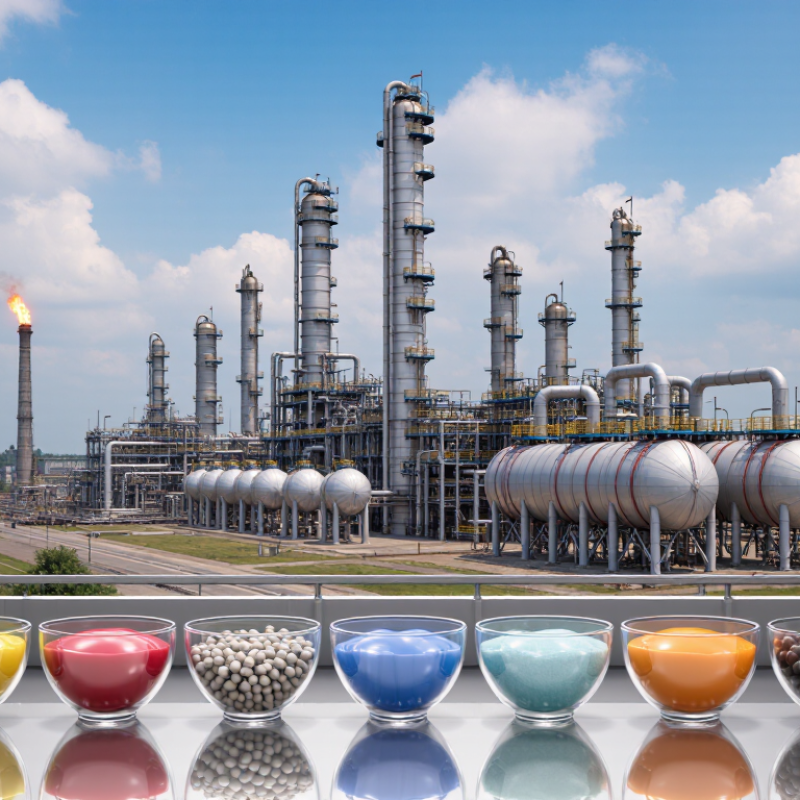
Petroleum refining catalysts are engineered materials that speed up chemical reactions without being consumed in the process. They usually contain active metals, acidic compounds, or porous mineral supports. Their tiny pores expose more reaction sites, allowing heavy hydrocarbon molecules to contact the catalyst efficiently. The result can be cleaner fuels, lighter products, or improved octane quality.
In fluid catalytic cracking, acidic catalyst sites break large hydrocarbon chains into smaller molecules. Hydrocracking combines hydrogen, pressure, and metal functions to produce cleaner middle distillates. Hydrotreating catalysts remove sulfur, nitrogen, and other unwanted compounds through reactions with hydrogen. Reforming catalysts rearrange molecules and can increase gasoline octane. Alkylation catalysts help combine smaller molecules into valuable fuel components.
Operating conditions matter as much as catalyst design. Temperature, pressure, feed quality, and hydrogen purity can change performance significantly. Coke may cover active sites, while metals and impurities can permanently reduce activity. Regeneration can restore some performance, but not all of it. No catalyst performs perfectly.
Global buyers should examine conversion data, product selectivity, mechanical strength, and expected service life. Laboratory results may look impressive, yet refinery conditions can tell a different story. A practical evaluation should include representative feedstock, loading procedures, safety documentation, and compliance records. Small pilot trials often reveal problems that commercial brochures cannot show. Consistent monitoring remains essential because catalyst behavior changes during operation.
Seven Key Catalyst Types Used Across Modern Refineries
7 Best Petroleum Refining Catalysts for Global Buyers
Modern refineries rely on seven catalyst types for different conversion and purification duties. Fluid catalytic cracking catalysts convert heavy gas oil into gasoline-range products. Hydrocracking catalysts produce cleaner diesel, jet fuel, and naphtha under hydrogen pressure. Hydrotreating catalysts remove sulfur, nitrogen, and trace metals before downstream processing. These units often combine active metals with porous supports. Feed quality changes performance quickly.
Catalytic reforming catalysts raise octane and generate hydrogen from naphtha. Isomerization catalysts rearrange light paraffins, improving gasoline quality without adding aromatics. Alkylation catalysts combine light olefins with isoparaffins to create high-octane blending components. Sulfur-recovery catalysts support conversion of hydrogen sulfide into elemental sulfur. Each type needs different regeneration, temperature control, and poison management.
Scale matters. The IEA’s Oil 2024 report projects global oil demand will reach 105.4 million barrels per day by 2030. Meanwhile, OPEC’s World Oil Outlook 2024 projects demand near 123 million barrels per day by 2050. These forecasts differ, but both highlight continued regional variation. Buyers should compare catalyst life, pore structure, pressure drop, and replacement frequency. Price alone misleads.
Field results can challenge laboratory data. A catalyst may perform well with clean feed but deactivate rapidly when metals, water, or nitrogen rise. Refinery operators should review unit history, emissions requirements, hydrogen availability, and regeneration records before selection. No catalyst choice is perfect. Ageing remains underestimated.
How Each Catalyst Supports Specific Refining Processes
7 Best Petroleum Refining Catalysts for Global Buyers
How Each Catalyst Supports Specific Refining Processes
Refinery economics increasingly depend on catalyst fit, not simply catalyst price. The International Energy Agency’s Oil 2024 report expects about 6.3 million barrels per day of new refining capacity by 2030, exceeding projected demand growth. Fluid catalytic cracking catalysts convert vacuum gas oil into gasoline and light olefins. Hydrotreating catalysts remove sulfur and nitrogen before downstream processing. Hydrocracking catalysts use hydrogen to produce cleaner diesel, jet fuel, and naphtha from heavier feeds. Feed quality matters greatly.
Catalytic reforming catalysts raise octane and generate hydrogen for hydrotreaters. Isomerization catalysts rearrange light paraffins, improving gasoline octane without adding aromatics. Alkylation catalysts combine small olefins with isobutane to make high-octane blending components. Hydrodewaxing catalysts reshape waxy molecules, supporting low-temperature diesel performance and lubricant production. Small temperature changes can alter results. A reactor outlet near 350°C may show stable conversion, yet a contaminated feed can shorten catalyst life sharply.
The International Maritime Organization’s sulfur limit of 0.50% has increased attention toward deep desulfurization and reliable hydrogen supply. OPEC’s World Oil Outlook 2024 also identifies petrochemicals and aviation as continuing oil-demand drivers, making product flexibility valuable. Buyers should compare activity, regeneration needs, pressure tolerance, and spent-catalyst handling. A strong laboratory result is not enough. Pilot testing with actual refinery feed remains essential. No catalyst fits every unit perfectly.
7 Best Petroleum Refining Catalysts for Global Buyers
How Each Catalyst Supports Specific Refining Processes
The chart compares representative operating-temperature windows for seven widely used catalyst systems in petroleum refining. Actual conditions vary with feedstock quality, hydrogen pressure, reactor design, catalyst age, and product targets.
Factors Global Buyers Should Compare Before Purchasing
Before choosing among the seven leading petroleum refining catalysts, global buyers should compare performance against their actual feedstock. Start with the feed. Sulfur, nitrogen, metals, and heavier molecules can reduce catalyst activity. A catalyst suited to clean feed may fail in a high-contaminant unit. Ask suppliers for test results using comparable operating conditions, not only laboratory averages.
Activity matters, but selectivity often matters more. A strong catalyst should support the target conversion while limiting unwanted gases, coke, and hydrogen consumption. Compare operating temperature, pressure, cycle length, and regeneration needs. Small differences can change refinery economics. Check pore structure, particle strength, and resistance to crushing during loading and circulation. Data matters.
Global purchasing also requires practical evaluation. Review production capacity, batch consistency, shipping conditions, storage life, and technical support near the refinery. Confirm that safety documents and environmental information meet local requirements. Total cost includes replacement frequency, downtime, disposal, and process adjustments. The cheapest purchase may create expensive interruptions. Fit beats fashion.
Buyers should request independent analysis, reference performance, and a clear warranty scope. Be cautious when claims lack feed-specific evidence. Supplier forecasts can be useful, but they are not operating history. A controlled trial may reveal pressure-drop problems or faster deactivation. That is inconvenient, yet valuable. Good decisions leave room for uncertainty and continued review.
Storage, Quality Control, and Supplier Evaluation Guidelines
Global buyers should treat catalyst storage as a quality-control step, not a warehouse task. Moisture, dust, and temperature swings can weaken pellets before loading. Keep unopened drums indoors, raised from the floor, with intact seals and visible lot codes. Use first-in, first-out rotation. Shorter storage is safer.
IEA’s Oil 2024 report projects global oil demand will increase by about 3.2 million barrels per day between 2023 and 2029. This slower growth makes catalyst efficiency and replacement planning more important. Buyers should request a current certificate of analysis, including surface area, pore volume, activity, attrition, moisture, and trace-metal limits. Test critical properties through an ISO/IEC 17025-accredited laboratory when practical. A perfect-looking certificate is not enough.
Supplier evaluation should include production-lot traceability, packaging records, safety data sheets, complaint history, and documented change control. Ask how the supplier protects catalyst quality during ocean transport and customs delays. Review storage instructions before signing a purchase contract. The Energy Institute’s Statistical Review of World Energy 2024 shows continued dependence on oil across major markets, but regional quality requirements still differ. One checklist cannot fit every refinery. Missing test data should be treated as a risk, not a minor paperwork gap.